Museum Technician and Conservator
Museum Technician and Conservator
Career Overview
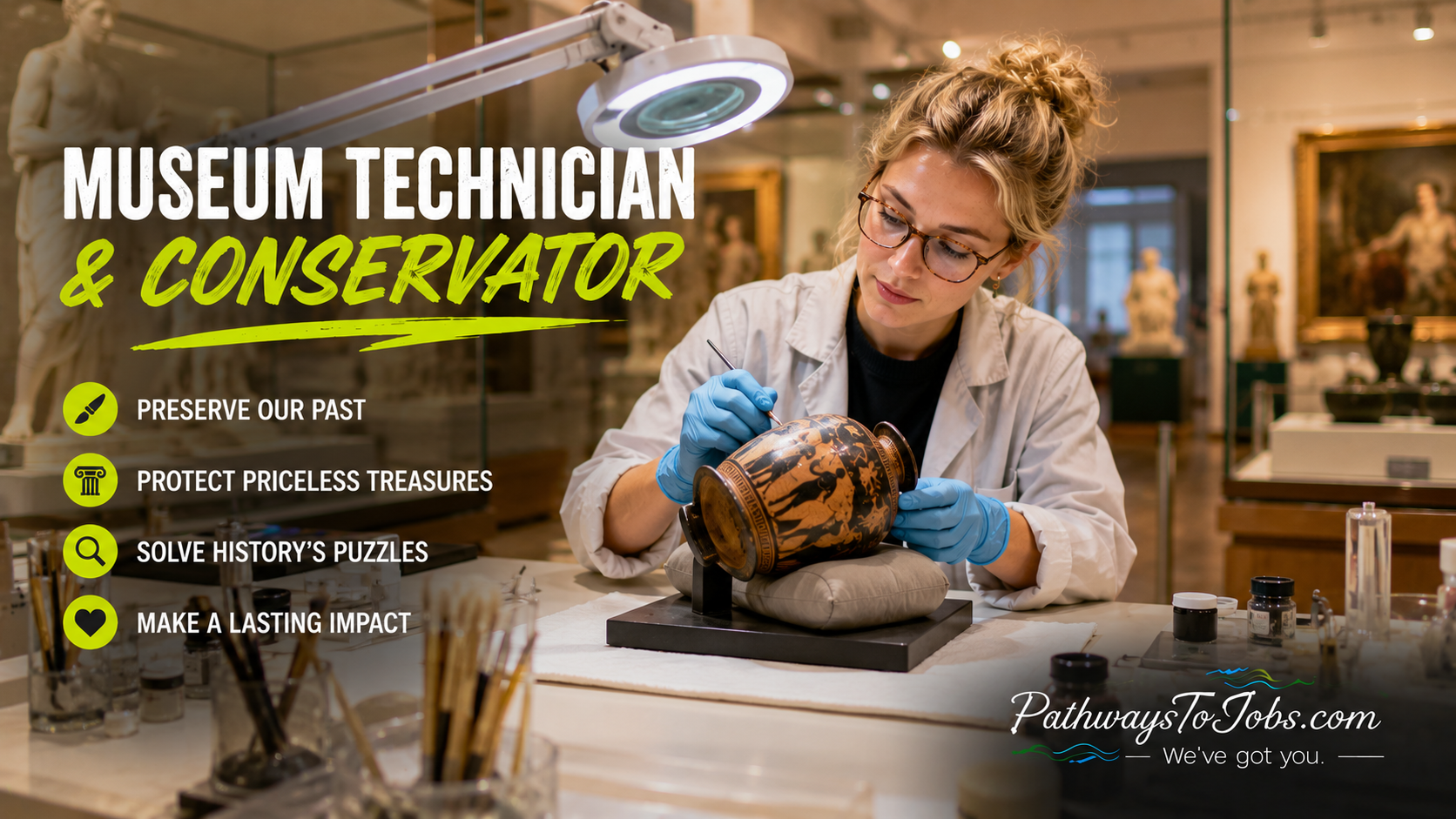
Museum technicians and conservators protect, restore, and prepare artwork, artifacts, fossils, textiles, and other important objects. The work combines history, science, creativity, and technology. You might use digital imaging, 3D scanning, specialized equipment, and collection databases to examine and preserve objects for future generations.
Education
Museum technicians often study museum technology, conservation technology, heritage studies, or a related field. Conservators typically need more specialized education, often including a master's degree in conservation. Hands-on experience through internships or museum placements can be valuable.
Work Environment
You could work in museums, galleries, archives, historic sites, universities, laboratories, or cultural organizations. The work may involve conservation labs, exhibition spaces, and collections storage, combining hands-on work with research and digital technology.
Future Outlook
Museum collections are becoming increasingly digital, creating new opportunities to combine traditional conservation skills with technologies such as 3D scanning, digital imaging, and AI-supported tools. In the U.S., Museum Technicians and Conservators are currently classified as a Bright Outlook occupation. Opportunities vary by location and specialization.
Recommended High School Courses
- Chemistry
- Biology
- Computer Science
- Art
- Communication
- History
- Archeology and Culture
- English
- Mathematics
- Design or Media Arts
- Active Learning - Understanding the implications of new information for both current and future problem-solving and decision-making.
- Active Listening - Giving full attention to what other people are saying, taking time to understand the points being made, asking questions as appropriate, and not interrupting at inappropriate times.
- Complex Problem Solving - Identifying complex problems and reviewing related information to develop and evaluate options and implement solutions.
- Coordination - Adjusting actions in relation to others' actions.
- Critical Thinking - Using logic and reasoning to identify the strengths and weaknesses of alternative solutions, conclusions or approaches to problems.
- Instructing - Teaching others how to do something.
- Judgment and Decision Making - Considering the relative costs and benefits of potential actions to choose the most appropriate one.
- Monitoring - Monitoring/Assessing performance of yourself, other individuals, or organizations to make improvements or take corrective action.
- Reading Comprehension - Understanding written sentences and paragraphs in work related documents.
- Speaking - Talking to others to convey information effectively.
- Writing - Communicating effectively in writing as appropriate for the needs of the audience.
- Administration and Management - Knowledge of business and management principles involved in strategic planning, resource allocation, human resources modeling, leadership technique, production methods, and coordination of people and resources.
- Chemistry - Knowledge of the chemical composition, structure, and properties of substances and of the chemical processes and transformations that they undergo. This includes uses of chemicals and their interactions, danger signs, production techniques, and disposal methods.
- English Language - Knowledge of the structure and content of the English language including the meaning and spelling of words, rules of composition, and grammar.
- Fine Arts - Knowledge of the theory and techniques required to compose, produce, and perform works of music, dance, visual arts, drama, and sculpture.
- History and Archeology - Knowledge of historical events and their causes, indicators, and effects on civilizations and cultures.
- Public Safety and Security - Knowledge of relevant equipment, policies, procedures, and strategies to promote effective local, state, or national security operations for the protection of people, data, property, and institutions.
- Arm-Hand Steadiness - The ability to keep your hand and arm steady while moving your arm or while holding your arm and hand in one position.
- Category Flexibility - The ability to generate or use different sets of rules for combining or grouping things in different ways.
- Deductive Reasoning - The ability to apply general rules to specific problems to produce answers that make sense.
- Far Vision - The ability to see details at a distance.
- Finger Dexterity - The ability to make precisely coordinated movements of the fingers of one or both hands to grasp, manipulate, or assemble very small objects.
- Flexibility of Closure - The ability to identify or detect a known pattern (a figure, object, word, or sound) that is hidden in other distracting material.
- Fluency of Ideas - The ability to come up with a number of ideas about a topic (the number of ideas is important, not their quality, correctness, or creativity).
- Inductive Reasoning - The ability to combine pieces of information to form general rules or conclusions (includes finding a relationship among seemingly unrelated events).
- Information Ordering - The ability to arrange things or actions in a certain order or pattern according to a specific rule or set of rules (e.g., patterns of numbers, letters, words, pictures, mathematical operations).
- Manual Dexterity - The ability to quickly move your hand, your hand together with your arm, or your two hands to grasp, manipulate, or assemble objects.
- Near Vision - The ability to see details at close range (within a few feet of the observer).
- Oral Comprehension - The ability to listen to and understand information and ideas presented through spoken words and sentences.
- Oral Expression - The ability to communicate information and ideas in speaking so others will understand.
- Originality - The ability to come up with unusual or clever ideas about a given topic or situation, or to develop creative ways to solve a problem.
- Problem Sensitivity - The ability to tell when something is wrong or is likely to go wrong. It does not involve solving the problem, only recognizing there is a problem.
- Selective Attention - The ability to concentrate on a task over a period of time without being distracted.
- Speech Clarity - The ability to speak clearly so others can understand you.
- Speech Recognition - The ability to identify and understand the speech of another person.
- Visual Color Discrimination - The ability to match or detect differences between colors, including shades of color and brightness.
- Visualization - The ability to imagine how something will look after it is moved around or when its parts are moved or rearranged.
- Written Comprehension - The ability to read and understand information and ideas presented in writing.
- Written Expression - The ability to communicate information and ideas in writing so others will understand.
- Construct exhibits or parts of exhibits.
- Prepare materials for preservation, storage, or display.
- Classify materials according to standard systems.
- Direct department activities.
- Evaluate characteristics of archival or historical objects.
- Inspect materials or equipment to determine need for repair or replacement.
- Maintain operational records.
- Enter information into databases or software programs.
- Record research or operational data.
- Advise educators on curricula, instructional methods, or policies.
- Develop policies or procedures for archives, museums or libraries.
- Direct activities of subordinates.
- Discuss problems or issues with supervisors.
- Research topics in area of expertise.
- Plan community programs or activities for the general public.
Schools


Potential Scholarships
Approx Salary Expectation
Related Careers


References
Trend Analysis - Explorer the Market, Labour Market Information, Government of Canada https://www.jobbank.gc.ca/trend-analysis.
O*NET OnLine, National Center for O*NET Development, https://www.onetonline.org/.