EMTs and Paramedics
EMTs and Paramedics
Career Overview
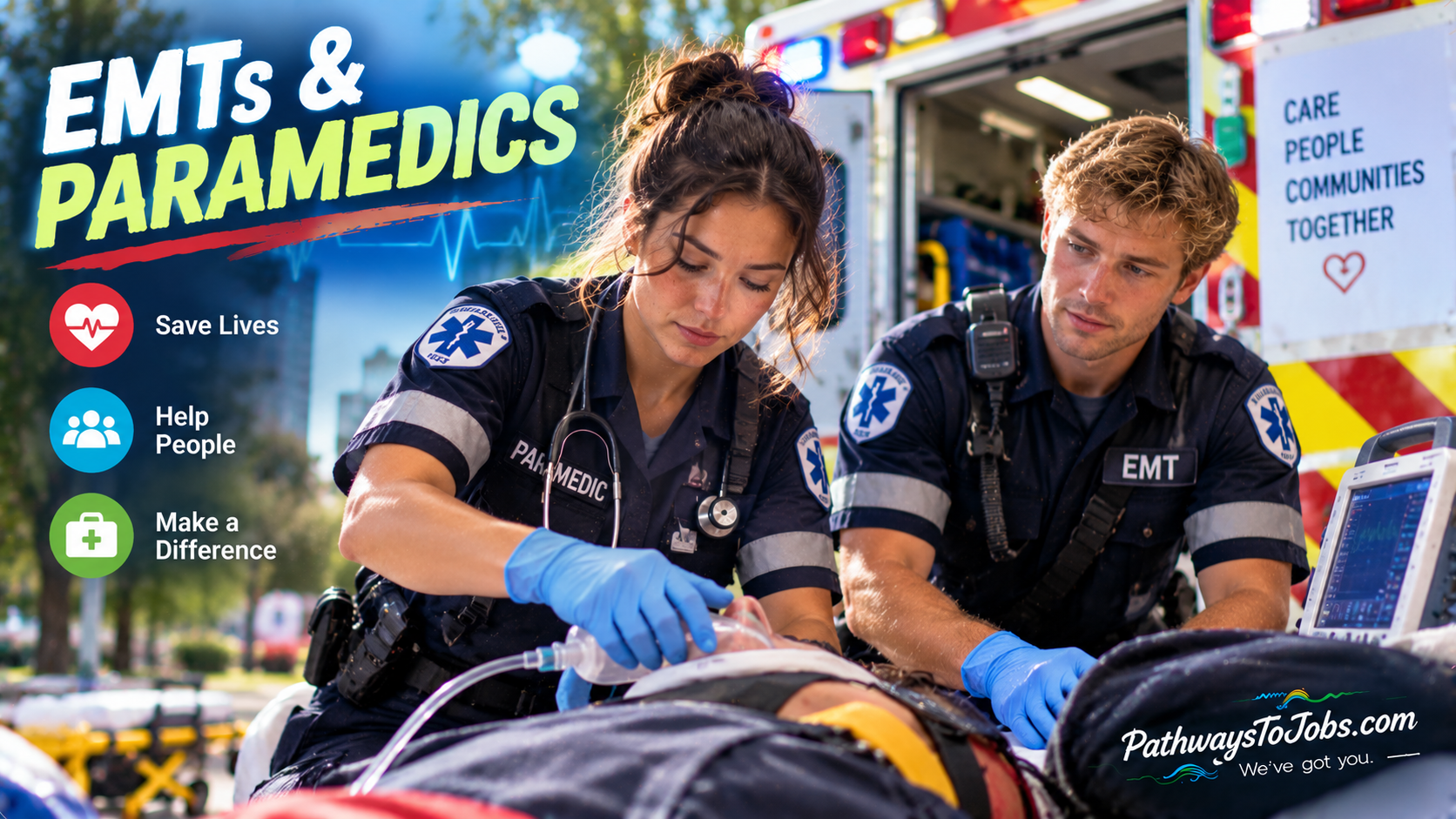
EMTs and Paramedics provide emergency medical care when people are seriously ill or injured. They assess patients, provide lifesaving treatment, stabilize them, and transport them to medical facilities when needed. Paramedics have more advanced training and can perform more complex procedures, administer a wider range of medications, and use advanced medical equipment. Modern emergency care also uses electronic patient records, GPS, mobile communications, and increasingly sophisticated monitoring technology. *(Experienced paramedics in specialized roles, such as critical care, flight, or tactical paramedicine, earn more depending on their level of training, experience, responsibilities, and employer.)
Education
Training depends on the level of emergency care you want to provide. EMT/entry-level emergency medical training can be completed through a shorter postsecondary program. Becoming a Primary Care Paramedic generally requires a two-year college program that includes classroom, laboratory, clinical, and field training. Advanced practice roles, such as Advanced Care Paramedic and Critical Care Paramedic, require additional education, clinical experience, and advanced certifications.
Work Environment
EMTs and Paramedics work in ambulances, hospitals, fire and rescue services, and other emergency response settings. They may work outdoors, in traffic, at accident scenes, or in difficult weather and other unpredictable conditions. The work can involve lifting and moving patients, long shifts, and high-pressure situations where quick decisions are essential.
Future Outlook
The need for emergency medical care is expected to remain strong. An aging population will increase emergencies related to falls, heart conditions, strokes, and other medical problems, while accidents, injuries, and natural disasters will continue to require emergency response. The profession is also evolving through mobile medical technology, electronic patient records, remote monitoring, advanced diagnostic equipment, and improved communication systems.
Recommended High School Courses
- Chemistry
- Biology
- Math
- Physical Education
- English
- Health science
- Active Listening - Giving full attention to what other people are saying, taking time to understand the points being made, asking questions as appropriate, and not interrupting at inappropriate times.
- Chemistry - Knowledge of the chemical composition, structure, and properties of substances and of the chemical processes and transformations that they undergo. This includes uses of chemicals and their interactions, danger signs, production techniques, and disposal methods.
- Computers and Electronics - Knowledge of circuit boards, processors, chips, electronic equipment, and computer hardware and software, including applications and programming.
- Coordination - Adjusting actions in relation to others' actions.
- Critical Thinking - Using logic and reasoning to identify the strengths and weaknesses of alternative solutions, conclusions or approaches to problems.
- Instructing - Teaching others how to do something.
- Judgment and Decision Making - Considering the relative costs and benefits of potential actions to choose the most appropriate one.
- Management of Material Resources - Obtaining and seeing to the appropriate use of equipment, facilities, and materials needed to do certain work.
- Mathematics - Using mathematics to solve problems.
- Monitoring - Monitoring/Assessing performance of yourself, other individuals, or organizations to make improvements or take corrective action.
- Reading Comprehension - Understanding written sentences and paragraphs in work related documents.
- Service Orientation - Actively looking for ways to help people.
- Social Perceptiveness - Being aware of others' reactions and understanding why they react as they do.
- Speaking - Talking to others to convey information effectively.
- Time Management - Managing one's own time and the time of others.
- Biology - Knowledge of plant and animal organisms, their tissues, cells, functions, interdependencies, and interactions with each other and the environment.
- Chemistry - Knowledge of the chemical composition, structure, and properties of substances and of the chemical processes and transformations that they undergo. This includes uses of chemicals and their interactions, danger signs, production techniques, and disposal methods.
- Computers and Electronics - Knowledge of circuit boards, processors, chips, electronic equipment, and computer hardware and software, including applications and programming.
- English Language - Knowledge of the structure and content of the English language including the meaning and spelling of words, rules of composition, and grammar.
- Medicine and Dentistry - Knowledge of the information and techniques needed to diagnose and treat human injuries, diseases, and deformities. This includes symptoms, treatment alternatives, drug properties and interactions, and preventive health-care measures.
- Transportation - Knowledge of principles and methods for moving people or goods by air, rail, sea, or road, including the relative costs and benefits.
- Active Listening - Giving full attention to what other people are saying, taking time to understand the points being made, asking questions as appropriate, and not interrupting at inappropriate times.
- Coordination - Adjusting actions in relation to others' actions.
- Critical Thinking - Using logic and reasoning to identify the strengths and weaknesses of alternative solutions, conclusions or approaches to problems.
- Deductive Reasoning - The ability to apply general rules to specific problems to produce answers that make sense.
- Judgment and Decision Making - Considering the relative costs and benefits of potential actions to choose the most appropriate one.See more occupations related to this skill.
- Monitoring - Monitoring/Assessing performance of yourself, other individuals, or organizations to make improvements or take corrective action.
- Near Vision - The ability to see details at close range (within a few feet of the observer).
- Oral Comprehension - The ability to listen to and understand information and ideas presented through spoken words and sentences.
- Oral Expression - The ability to communicate information and ideas in speaking so others will understand.
- Social Perceptiveness - Being aware of others' reactions and understanding why they react as they do.
- Speech Clarity - The ability to speak clearly so others can understand you.
- Speech Recognition - The ability to identify and understand the speech of another person.
- Time Management - Managing one's own time and the time of others.
- Writing - Communicating effectively in writing as appropriate for the needs of the audience.See more occupations related to this skill.
- Treat medical emergencies.
- Administer intravenous medications.
- Administer non-intravenous medications.
- Collaborate with healthcare professionals to plan or provide treatment.
- Implement advanced life support techniques.
- Analyze patient data to determine patient needs or treatment goals.
- Inform medical professionals regarding patient conditions and care.
- Interact with patients to build rapport or provide emotional support.
- Maintain medical or professional knowledge.
- Monitor patient progress or responses to treatments.
- Operate diagnostic or therapeutic medical instruments or equipment.
- Record patient medical histories.
- Teach medical procedures to healthcare personnel.
- Train medical providers.
Schools


Potential Scholarships
Approx Salary Expectation
Related Careers

References
Trend Analysis - Explorer the Market, Labour Market Information, Government of Canada https://www.jobbank.gc.ca/trend-analysis.
O*NET OnLine, National Center for O*NET Development, https://www.onetonline.org/.