Computer Support Specialists
Computer Support Specialists

Career Overview
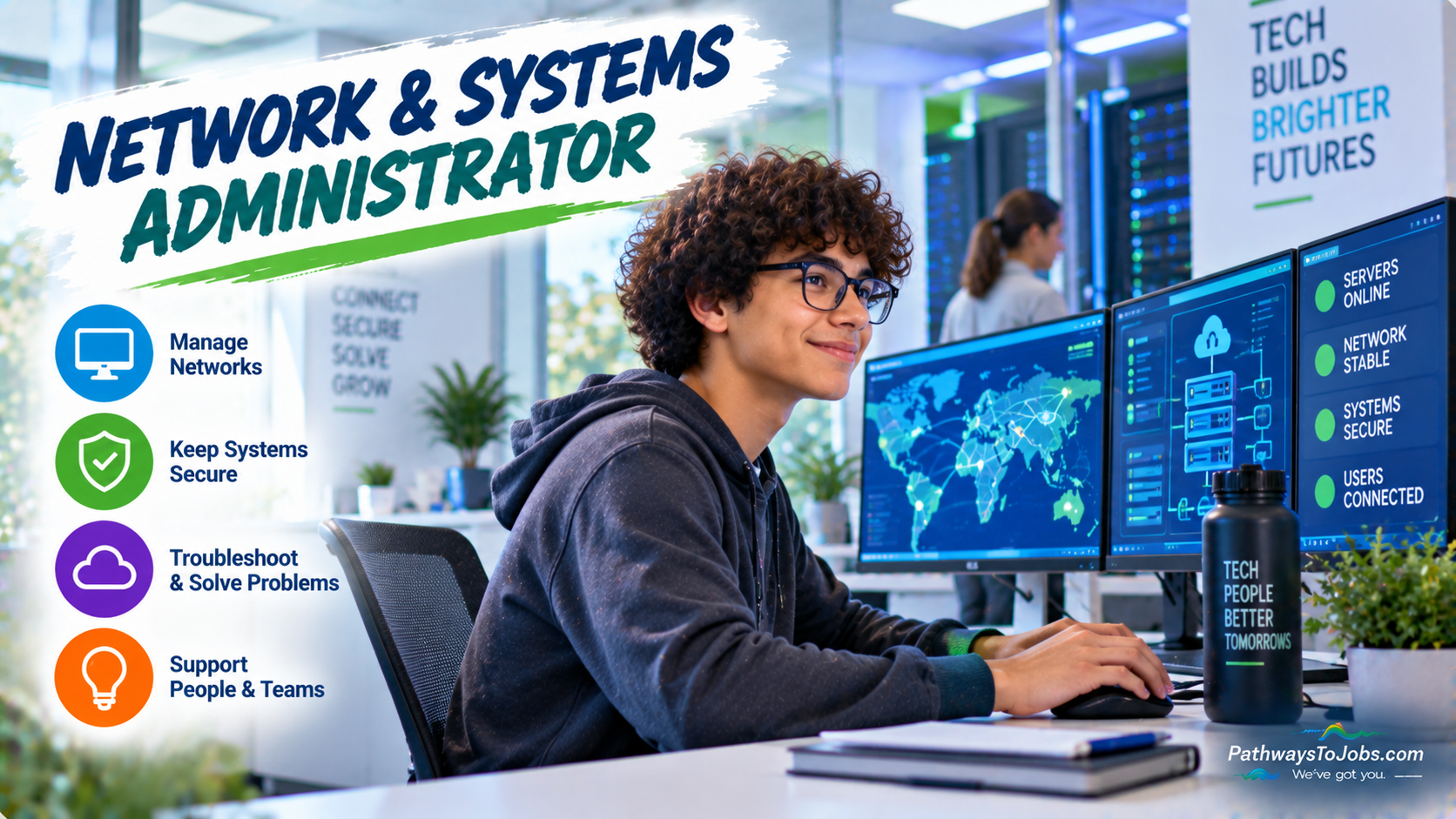
Computer support specialists help people and organizations solve technology problems. They troubleshoot hardware, software, networks, and devices, provide technical guidance, and help keep digital systems running smoothly. Modern support specialists may also work with cloud services, cybersecurity, automation, and AI-powered tools.
Education
A college diploma in computer science, computer programming, network administration, or information technology is a common pathway. Some positions may accept a high school diploma combined with IT certifications, technical training, or experience. Vendor certifications can also help.
Work Environment
Computer support specialists work in technology companies, businesses, schools, government, healthcare, and other organizations. They may work in an office, remotely, or provide support by phone and online. Some positions require evening or weekend support.
Future Outlook
Technology continues to change how support specialists work, with cloud computing, cybersecurity, automation, and AI becoming increasingly important. While some routine support tasks can be automated, organizations will continue to need skilled professionals who can troubleshoot problems and help people use technology effectively. Current employment projections vary by country, with replacement openings continuing to provide opportunities.
Recommended High School Courses
- Computer Science
- Business
- English
- Mathematics
- Data Science
- Information Tech
- Data Management
- Active Listening - Giving full attention to what other people are saying, taking time to understand the points being made, asking questions as appropriate, and not interrupting at inappropriate times.
- Complex Problem Solving - Identifying complex problems and reviewing related information to develop and evaluate options and implement solutions.
- Critical Thinking - Using logic and reasoning to identify the strengths and weaknesses of alternative solutions, conclusions or approaches to problems.
- Reading Comprehension - Understanding written sentences and paragraphs in work related documents.
- Speaking - Talking to others to convey information effectively.
- Computers and Electronics - Knowledge of circuit boards, processors, chips, electronic equipment, and computer hardware and software, including applications and programming.
- Customer and Personal Service - Knowledge of principles and processes for providing customer and personal services. This includes customer needs assessment, meeting quality standards for services, and evaluation of customer satisfaction.
- Engineering and Technology - Knowledge of the practical application of engineering science and technology. This includes applying principles, techniques, procedures, and equipment to the design and production of various goods and services.
- English Language - Knowledge of the structure and content of the English language including the meaning and spelling of words, rules of composition, and grammar.
- Public Safety and Security - Knowledge of relevant equipment, policies, procedures, and strategies to promote effective local, state, or national security operations for the protection of people, data, property, and institutions.
- Telecommunications - Knowledge of transmission, broadcasting, switching, control, and operation of telecommunications systems.
- Category Flexibility - The ability to generate or use different sets of rules for combining or grouping things in different ways.
- Deductive Reasoning - The ability to apply general rules to specific problems to produce answers that make sense.
- Finger Dexterity - The ability to make precisely coordinated movements of the fingers of one or both hands to grasp, manipulate, or assemble very small objects.
- Fluency of Ideas - The ability to come up with a number of ideas about a topic (the number of ideas is important, not their quality, correctness, or creativity).
- Inductive Reasoning - The ability to combine pieces of information to form general rules or conclusions (includes finding a relationship among seemingly unrelated events).
- Information Ordering - The ability to arrange things or actions in a certain order or pattern according to a specific rule or set of rules (e.g., patterns of numbers, letters, words, pictures, mathematical operations).
- Near Vision - The ability to see details at close range (within a few feet of the observer).
- Oral Comprehension - The ability to listen to and understand information and ideas presented through spoken words and sentences.
- Oral Expression - The ability to communicate information and ideas in speaking so others will understand.
- Problem Sensitivity - The ability to tell when something is wrong or is likely to go wrong. It does not involve solving the problem, only recognizing there is a problem.
- Speech Clarity - The ability to speak clearly so others can understand you.
- Speech Recognition - The ability to identify and understand the speech of another person.
- Written Comprehension - The ability to read and understand information and ideas presented in writing.
- Written Expression - The ability to communicate information and ideas in writing so others will understand.
- Provide technical support for software maintenance or use.
- Monitor computer system performance to ensure proper operation.
- Read documents to gather technical information.
- Collaborate with others to resolve information technology issues.
- Resolve computer software problems.
- Install computer hardware.
- Teach others to use computer equipment or hardware.
- Train others in computer interface or software use.
- Test software performance.
- Modify software programs to improve performance.
- Test computer hardware performance.
- Document operational activities.
- Install computer software.
- Maintain computer hardware.
- Evaluate utility of software or hardware technologies.
- Provide recommendations to others about computer hardware.
- Recommend changes to improve computer or information systems.
- Collaborate with others to determine design specifications or details.
- Conduct research to gain information about products or processes.
- Update knowledge about emerging industry or technology trends.
- Participate in staffing decisions.
- Supervise information technology personnel.
Schools


Potential Scholarships
Approx Salary Expectation
Related Careers



References
Trend Analysis - Explorer the Market, Labour Market Information, Government of Canada https://www.jobbank.gc.ca/trend-analysis.
WorkBC's Career Trek, http://www.careertrekbc.ca/.
O*NET OnLine, National Center for O*NET Development, https://www.onetonline.org/.