Medical Records & Health Info Techs
Medical Records & Health Info Techs
Career Overview
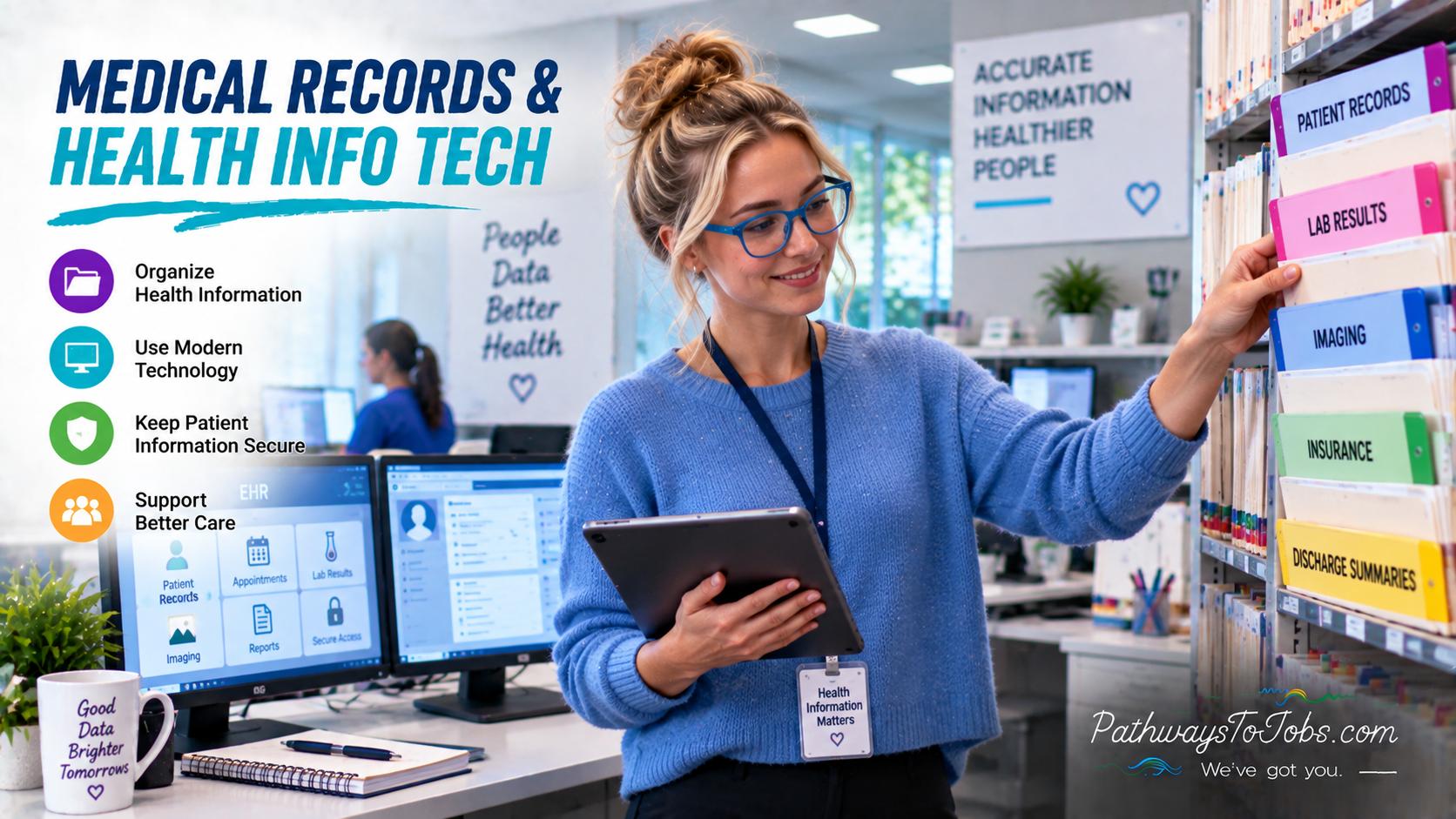
Medical Records and Health Information Technicians organize, code, protect, and manage patient health information. They work with electronic health records, medical coding systems, databases, and health information technology, helping make sure medical information is accurate, secure, and available to the right people.
Education
A two-year college diploma or associate-level program in Health Information Management, Health Information Technology, or a related field is the most direct pathway. Programs typically include medical terminology, health records, coding, data management, privacy, and health information systems. Professional certification may be required or preferred, depending on the employer and location.
Work Environment
Medical Records and Health Information Technicians work in hospitals, clinics, medical offices, government health organizations, and other healthcare settings. Much of the work is computer-based, involving electronic health records, databases, coding systems, and confidential patient information. Some positions can be performed remotely.
Future Outlook
The need for accurate, secure health information is growing as healthcare becomes increasingly digital. Electronic health records, health databases, cybersecurity, data analytics, AI, and other technologies are changing how patient information is collected and managed. As healthcare systems generate more digital information, professionals who understand both healthcare and technology will remain important. Medical records specialists are projected to experience stronger-than-average employment growth, while automation and AI will increasingly handle some routine coding and data tasks.
Recommended High School Courses
- Biology
- Math
- English
- Health science
- Computer Studies
- Active Listening - Giving full attention to what other people are saying, taking time to understand the points being made, asking questions as appropriate, and not interrupting at inappropriate times.
- Critical Thinking - Using logic and reasoning to identify the strengths and weaknesses of alternative solutions, conclusions or approaches to problems.
- Reading Comprehension - Understanding written sentences and paragraphs in work related documents.
- Speaking - Talking to others to convey information effectively.
- Writing - Communicating effectively in writing as appropriate for the needs of the audience.
- Clerical - Knowledge of administrative and clerical procedures and systems such as word processing, managing files and records, stenography and transcription, designing forms, and other office procedures and terminology.
- Computers and Electronics - Knowledge of circuit boards, processors, chips, electronic equipment, and computer hardware and software, including applications and programming.
- Customer and Personal Service - Knowledge of principles and processes for providing customer and personal services. This includes customer needs assessment, meeting quality standards for services, and evaluation of customer satisfaction.
- English Language - Knowledge of the structure and content of the English language including the meaning and spelling of words, rules of composition, and grammar.
- Category Flexibility - The ability to generate or use different sets of rules for combining or grouping things in different ways.
- Deductive Reasoning - The ability to apply general rules to specific problems to produce answers that make sense.
- Information Ordering - The ability to arrange things or actions in a certain order or pattern according to a specific rule or set of rules (e.g., patterns of numbers, letters, words, pictures, mathematical operations).
- Near Vision - The ability to see details at close range (within a few feet of the observer).
- Oral Comprehension - The ability to listen to and understand information and ideas presented through spoken words and sentences.
- Oral Expression - The ability to communicate information and ideas in speaking so others will understand.
- Speech Recognition - The ability to identify and understand the speech of another person.
- Written Comprehension - The ability to read and understand information and ideas presented in writing.
- Written Expression - The ability to communicate information and ideas in writing so others will understand.
- Monitor medical facility activities to ensure adherence to standards or regulations.
- Process healthcare paperwork.
- Perform clerical work in medical settings.
- Enter patient or treatment data into computers.
- Maintain medical facility records.
- Present medical research reports.
- Process medical billing information.
- Record patient medical histories.
- Manage healthcare operations.
- Supervise medical support personnel.
- Prepare official health documents or records.
- Train caregivers or other non-medical personnel.
- Maintain medical or professional knowledge.
- Prepare healthcare training materials.
Schools


Potential Scholarships
Approx Salary Expectation
Related Careers

References
Trend Analysis - Explorer the Market, Labour Market Information, Government of Canada https://www.jobbank.gc.ca/trend-analysis.
O*NET OnLine, National Center for O*NET Development, https://www.onetonline.org/.