Biomedical Equipment Technician
Biomedical Equipment Technician
Career Overview
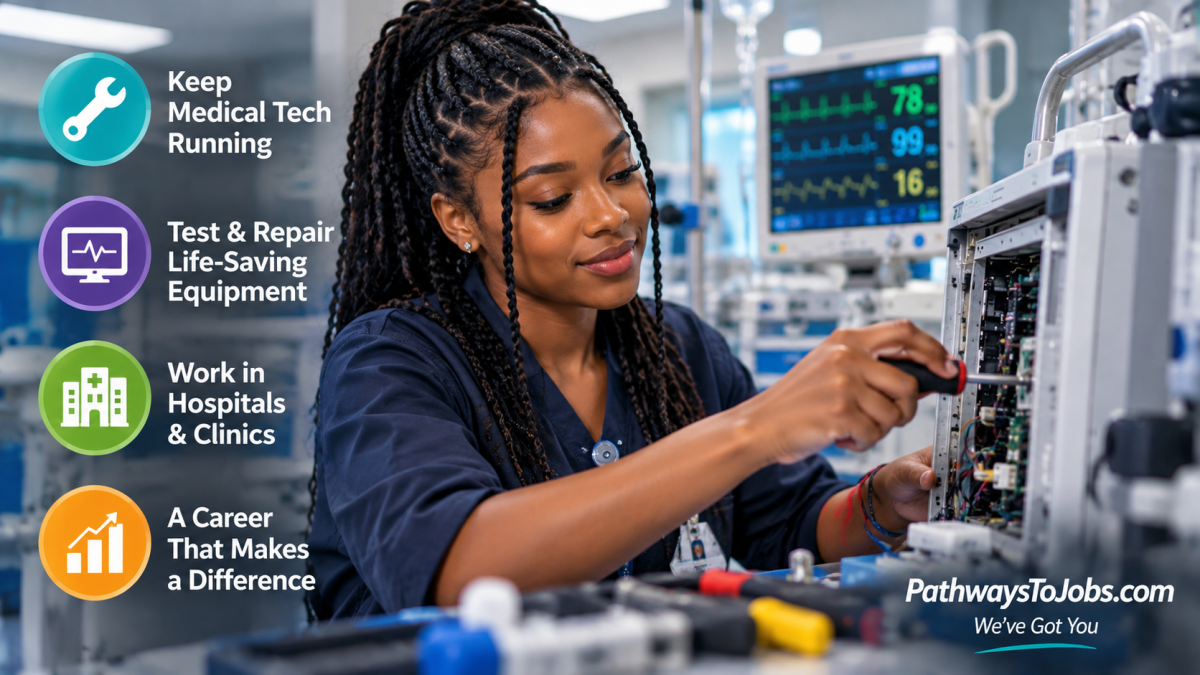
Biomedical Equipment Technicians (BMETs) keep the technology used in healthcare safe, accurate, and ready to work. They install, inspect, test, calibrate, maintain, and repair medical equipment, including patient monitors, infusion pumps, ventilators, defibrillators, and diagnostic systems. They combine electronics, computers, mechanics, and healthcare technology to solve problems that can directly affect patient care.
Education
Most Biomedical Equipment Technicians complete a college diploma, associate degree, or certificate in Biomedical Engineering Technology, Biomedical Equipment Technology, electronics, or a related field. Programs typically include electronics, electrical circuits, computer systems and networking, anatomy and physiology, medical devices, safety standards, and troubleshooting. Hands-on laboratory training and work placements are common. Professional certifications may also be available after graduation, although requirements vary by country and employer.
Work Environment
Biomedical Equipment Technicians work mainly in hospitals, clinics, laboratories, medical equipment companies, and service organizations. Much of the work is indoors in clean, technology-focused environments, but technicians may move throughout healthcare facilities or travel to customer sites. The job combines computer work with hands-on testing and repair. Some positions require technicians to be on call during evenings or weekends when important medical equipment fails.
Future Outlook
The future outlook for Biomedical Equipment Technicians is strong as hospitals and healthcare providers rely on increasingly advanced medical technology. In the United States, employment of medical equipment repairers is projected to grow 13% from 2025 to 2035, much faster than the average for all occupations, with about 8,200 openings expected each year. As medical devices become more sophisticated and healthcare systems use more connected technology, skilled technicians will remain needed to keep equipment safe and functioning properly.
Recommended High School Courses
- Chemistry
- Biology
- Electronics
- Computer Science
- Physics
- English
- Mathematics
- Health science
- Complex Problem Solving - Identifying complex problems and reviewing related information to develop and evaluate options and implement solutions.
- Equipment Maintenance - Performing routine maintenance on equipment and determining when and what kind of maintenance is needed.
- Equipment Selection - Determining the kind of tools and equipment needed to do a job.
- Judgment and Decision Making - Considering the relative costs and benefits of potential actions to choose the most appropriate one.
- Operation Monitoring - Watching gauges, dials, or other indicators to make sure a machine is working properly.
- Quality Control Analysis - Conducting tests and inspections of products, services, or processes to evaluate quality or performance.
- Repairing - Repairing machines or systems using the needed tools.
- Systems Analysis - Determining how a system should work and how changes in conditions, operations, and the environment will affect outcomes.
- Time Management - Managing one's own time and the time of others.
- Trouble Shooting - Finding and fixing problems when an AI tool, prompt, or process doesn't work as expected.
- Biology - Knowledge of plant and animal organisms, their tissues, cells, functions, interdependencies, and interactions with each other and the environment.
- Computers and Electronics - Knowledge of circuit boards, processors, chips, electronic equipment, and computer hardware and software, including applications and programming.
- Customer and Personal Service - Knowledge of principles and processes for providing customer and personal services. This includes customer needs assessment, meeting quality standards for services, and evaluation of customer satisfaction.
- Engineering and Technology - Knowledge of the practical application of engineering science and technology. This includes applying principles, techniques, procedures, and equipment to the design and production of various goods and services.
- Mathematics - Knowledge of arithmetic, algebra, geometry, calculus, statistics, and their applications.
- Mechanical - Knowledge of machines and tools, including their designs, uses, repair, and maintenance.
- Medicine and Dentistry - Knowledge of the information and techniques needed to diagnose and treat human injuries, diseases, and deformities. This includes symptoms, treatment alternatives, drug properties and interactions, and preventive health-care measures.
- Physics - Understands concepts such as electricity, force, energy, pressure and motion that affect how medical equipment operates.
- Public Safety and Security - Knowledge of relevant equipment, policies, procedures, and strategies to promote effective local, state, or national security operations for the protection of people, data, property, and institutions.
- Arm-Hand Steadiness - The ability to keep your hand and arm steady while moving your arm or while holding your arm and hand in one position.
- Deductive Reasoning - The ability to apply general rules to specific problems to produce answers that make sense.
- Finger Dexterity - The ability to make precisely coordinated movements of the fingers of one or both hands to grasp, manipulate, or assemble very small objects.
- Inductive Reasoning - The ability to combine pieces of information to form general rules or conclusions (includes finding a relationship among seemingly unrelated events).
- Information Ordering - The ability to arrange things or actions in a certain order or pattern according to a specific rule or set of rules (e.g., patterns of numbers, letters, words, pictures, mathematical operations).
- Manual Dexterity - The ability to quickly move your hand, your hand together with your arm, or your two hands to grasp, manipulate, or assemble objects.
- Near Vision - The ability to see details at close range (within a few feet of the observer).
- Problem Sensitivity - The ability to tell when something is wrong or is likely to go wrong. It does not involve solving the problem, only recognizing there is a problem.See more occupations related to this ability.
- Visualization - The ability to imagine how something will look after it is moved around or when its parts are moved or rearranged.
- Written Comprehension - The ability to read and understand information and ideas presented in writing.
- Repairing and Maintaining Electronic Equipment
- Making Decisions and Solving Problems
- Repairing and Maintaining Mechanical Equipment
- Inspecting Equipment, Structures or Materials
- Evaluating Information to Determine Compliance with Standards
- Organizing , Planning and Prioritizing Work
- Updating and Using Relevant Knowledge
- Documenting, Recording Information
- Monitoring Processes, Materials or Surroundings
- Working with Computers
Schools


Potential Scholarships
Approx Salary Expectation
Related Careers

References
“27-2011.00 - Actors.” O*NET OnLine, National Center for O*NET Development, http://www.onetonline.org/link/summary/27-2011.00. Accessed 8 October 2020.
Government of Canada – Job Bank