Court Reporter
Court Reporter
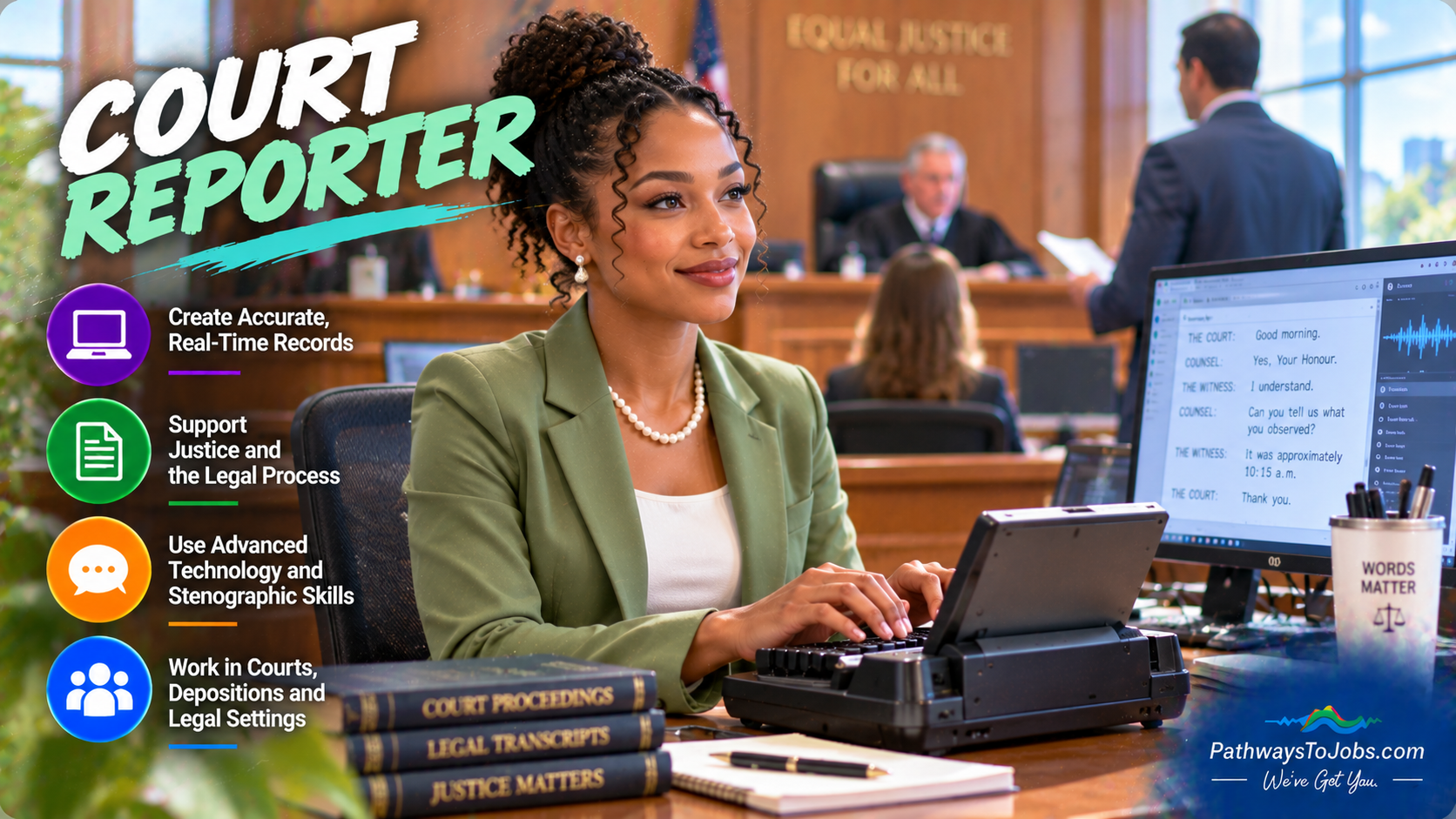
Career Overview
Court reporters create accurate, word-for-word transcripts of trials, hearings, depositions, and other legal proceedings. They use specialized digital recording and stenography technology to capture spoken information quickly and precisely.
Education
A college or specialized court reporting program is typically required. Training develops skills in stenography, transcription, legal terminology, and real-time captioning. Certification or licensing may be required depending on where you work
Work Environment
Court reporters work in courtrooms, law offices, government settings, and other legal environments. Some work independently or remotely, and digital reporting technology is increasingly part of the profession.
Future Outlook
Court reporting is evolving with digital recording, real-time transcription, and captioning technology. Opportunities will continue as courts and legal organizations need accurate records, while experienced professionals may also find opportunities in captioning, depositions, and other specialized settings. In some regions, retirements are expected to create additional openings.
Recommended High School Courses
- Computer Science
- Business
- Communication
- English
- Mathematics
- Law
- Active Listening - Giving full attention to what other people are saying, taking time to understand the points being made, asking questions as appropriate, and not interrupting at inappropriate times.
- Monitoring - Monitoring/Assessing performance of yourself, other individuals, or organizations to make improvements or take corrective action.
- Reading Comprehension - Understanding written sentences and paragraphs in work related documents.
- Speaking - Talking to others to convey information effectively.
- Time Management - Managing one's own time and the time of others.
- Writing - Communicating effectively in writing as appropriate for the needs of the audience.
- Administration and Management - Knowledge of business and management principles involved in strategic planning, resource allocation, human resources modeling, leadership technique, production methods, and coordination of people and resources.
- Clerical - Knowledge of administrative and clerical procedures and systems such as word processing, managing files and records, stenography and transcription, designing forms, and other office procedures and terminology.
- Communications and Media - Knowledge of media production, communication, and dissemination techniques and methods. This includes alternative ways to inform and entertain via written, oral, and visual media.
- Computers and Electronics - Knowledge of circuit boards, processors, chips, electronic equipment, and computer hardware and software, including applications and programming.
- Customer and Personal Service - Knowledge of principles and processes for providing customer and personal services. This includes customer needs assessment, meeting quality standards for services, and evaluation of customer satisfaction.
- English Language - Knowledge of the structure and content of the English language including the meaning and spelling of words, rules of composition, and grammar.
- Law and Government - Knowledge of laws, legal codes, court procedures, precedents, government regulations, executive orders, agency rules, and the democratic political process.
- Finger Dexterity - The ability to make precisely coordinated movements of the fingers of one or both hands to grasp, manipulate, or assemble very small objects.
- Information Ordering - The ability to arrange things or actions in a certain order or pattern according to a specific rule or set of rules (e.g., patterns of numbers, letters, words, pictures, mathematical operations).
- Near Vision - The ability to see details at close range (within a few feet of the observer).
- Oral Comprehension - The ability to listen to and understand information and ideas presented through spoken words and sentences.
- Oral Expression - The ability to communicate information and ideas in speaking so others will understand.
- Selective Attention - The ability to concentrate on a task over a period of time without being distracted.
- Speech Clarity - The ability to speak clearly so others can understand you.
- Speech Recognition - The ability to identify and understand the speech of another person.
- Wrist-Finger Speed - The ability to make fast, simple, repeated movements of the fingers, hands, and wrists.
- Written Comprehension - The ability to read and understand information and ideas presented in writing.
- Written Expression - The ability to communicate information and ideas in writing so others will understand.
- Record information from legal proceedings.
- Proofread documents, records, or other files to ensure accuracy.
- Enter information into databases or software programs.
- Provide information to the general public.
- File documents or records.
- Maintain the order of legal documents.
- Process forensic or legal evidence in accordance with procedures.
- Prepare legal documents.
- Type documents.
- Confer with court staff to clarify information.
- Review documents or materials for compliance with policies or regulations.
- Verify accuracy of records.
Schools


Potential Scholarships
Approx Salary Expectation


References
Trend Analysis - Explorer the Market, Labour Market Information, Government of Canada https://www.jobbank.gc.ca/trend-analysis.
O*NET OnLine, National Center for O*NET Development, https://www.onetonline.org/.