AI Governance Specialist
AI Governance Specialist
Career Overview
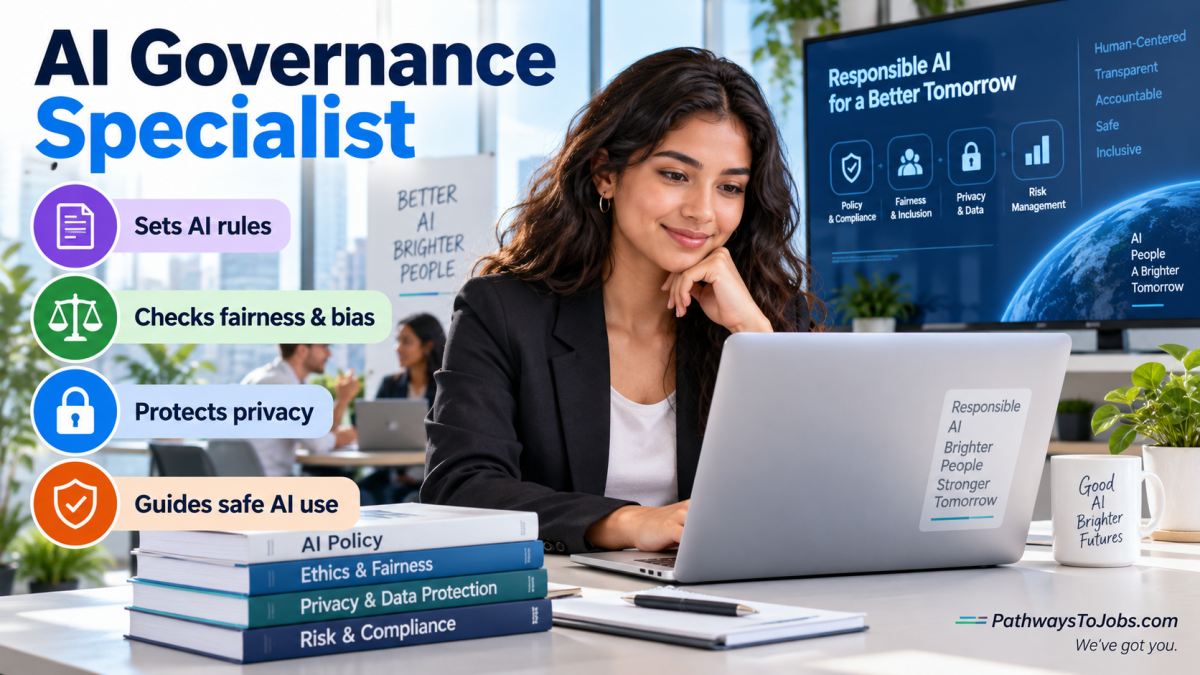
An AI Governance Specialist helps organizations use artificial intelligence safely, responsibly, and fairly. They create policies, assess AI risks, support AI compliance, and help make sure AI systems follow laws and ethical standards. This growing career is becoming increasingly important as more organizations use AI in everyday decision-making.
Education
Most AI Governance Specialists need a bachelor's degree in areas such as computer science, data science, information technology, business, law, public policy, or ethics. Courses in artificial intelligence, AI ethics, privacy, cybersecurity, risk management, regulation, and compliance are especially useful. Some employers may prefer a master's degree or professional training in AI governance or responsible AI, but it is not required for every position.
Work Environment
AI Governance Specialists usually work in offices or remote/hybrid settings for technology companies, banks, healthcare organizations, government, and consulting firms. They spend much of their time on computers reviewing AI risks and policies and working with technical, legal, and management teams. The work is usually professional, collaborative, and focused on solving new challenges as AI technology changes.
Future Outlook
Strong. Demand for AI Governance Specialists is expected to grow as more organizations use artificial intelligence and need people to manage its risks, rules, privacy, and ethical use. As AI laws and regulations expand, this emerging career should offer increasing opportunities in many industries.
Recommended High School Courses
- Computer Science
- English
- Mathematics
- Law
- Computer Science
- Social Sciences
- Philosophy / Ethics
- Attention to Detail - Carefully reviewing work to catch errors, inconsistencies, or omissions and ensure accuracy and quality in all outputs.
- Critical Thinking - Using logic and reasoning to identify the strengths and weaknesses of alternative solutions, conclusions or approaches to problems.
- Critical Thinking - Questioning information, recognizing problems, and deciding whether an AI response makes sense.
- Data Analysis - Examining data to find patterns, understand information, and support better decisions.
- Decision Making - Choosing a course of action by evaluating available options, weighing their potential outcomes, and applying sound judgment to reach an effective conclusion.
- Policy Development - Creating guidelines, rules, and frameworks that govern how organizations or systems should operate, ensuring consistency and compliance with legal and ethical standards.
- Problem Solving - Using logical and creative thinking to find solutions to challenges.
- Research - Finding and reviewing information to understand a topic and create better AI results.
- Risk Assessment - Identifying, analyzing, and evaluating potential risks to determine their likelihood and impact, and recommending measures to reduce or manage them.
- Teamwork - Working cooperatively with others toward a shared goal, contributing individual strengths while supporting colleagues to achieve collective success.
- AI Ethics - Understanding how to use AI responsibly, fairly, and safely.
- AI Governance - Understanding the policies and frameworks used to ensure AI systems are developed and used safely, ethically, and accountably.
- Artificial Intelligence - Understanding how computers and machines can perform tasks that normally require human intelligence.
- Business Practices - Understanding how organizations operate, including common processes, planning methods, and how decisions are made within companies.
- Cybersecurity - Knowledge of how to protect computer systems, networks, and data from unauthorized access, attacks, and damage.
- Data Privacy - Understanding the laws and best practices that govern how personal and sensitive data is collected, stored, and shared.
- Law and Regulation - Knowledge of legal frameworks and regulatory requirements that govern the development and use of technology and artificial intelligence.
- Responsible AI - Understanding how to design and deploy AI systems in a way that is ethical, transparent, fair, and accountable.
- Risk Management - Knowledge of how to identify, assess, and mitigate risks that could negatively impact an organization's operations or stakeholders.
- Technology Policy - Understanding the policies and governance frameworks that guide how technology is developed, regulated, and used within organizations and society.
- Adapt to new technology - Learn and adjust as new AI tools, systems, and technologies are introduced.
- Analyze Complex Information - Review data, reports, and evidence to draw meaningful conclusions and support informed decision-making.
- Explain Technical Ideas Clearly - Break down complex or technical concepts and communicate them in plain language that non-technical audiences can understand.
- Identify Risk - Spot potential threats, vulnerabilities, or negative consequences in AI systems, processes, or decisions before they cause harm.
- Interpret Policy and Regulation - Read and apply laws, regulations, and governance frameworks to determine what is permitted or required in a given situation.
- Make Sound Decisions - Weigh options, consider consequences, and choose the best course of action using available information and good judgment.
- Organize Information - Structure and categorize data, findings, or documents in a clear, logical way so they are easy to access and use.
- Recognize Ethical Issues - Notice when a situation involves moral questions or conflicts of interest and flag them for proper consideration.
- Solve Problems - Use logical and creative thinking to find effective solutions to challenges.
- Review AI Systems
- Develop AI Policies
- Monitor Compliance
- Research AI Laws and Regulations
- Work with Technical and Legal Teams
- Investigate Ethical Concerns
- Recommend Improvements
- Prepare Reports
- Help Guide Responsible AI Use
- Assess Risks
Schools


Potential Scholarships
Approx Salary Expectation
Related Careers



References
Government of Canada – Job Bank
Statistics Canada – Labour Force
Office of the Privacy Commissioner of Canada
Canadian Centre for Cyber Security
Bureau of Labor Statistics (BLS) – Occupational Employment and Wage Statistics
U.S. Bureau of Labor Statistics – Occupational Outlook Handbook U O*NET OnLine
National Institute of Standards and Technology (NIST)
International Association of Privacy Professionals (IAPP)