Surgical Technologists
Surgical Technologists
Career Overview
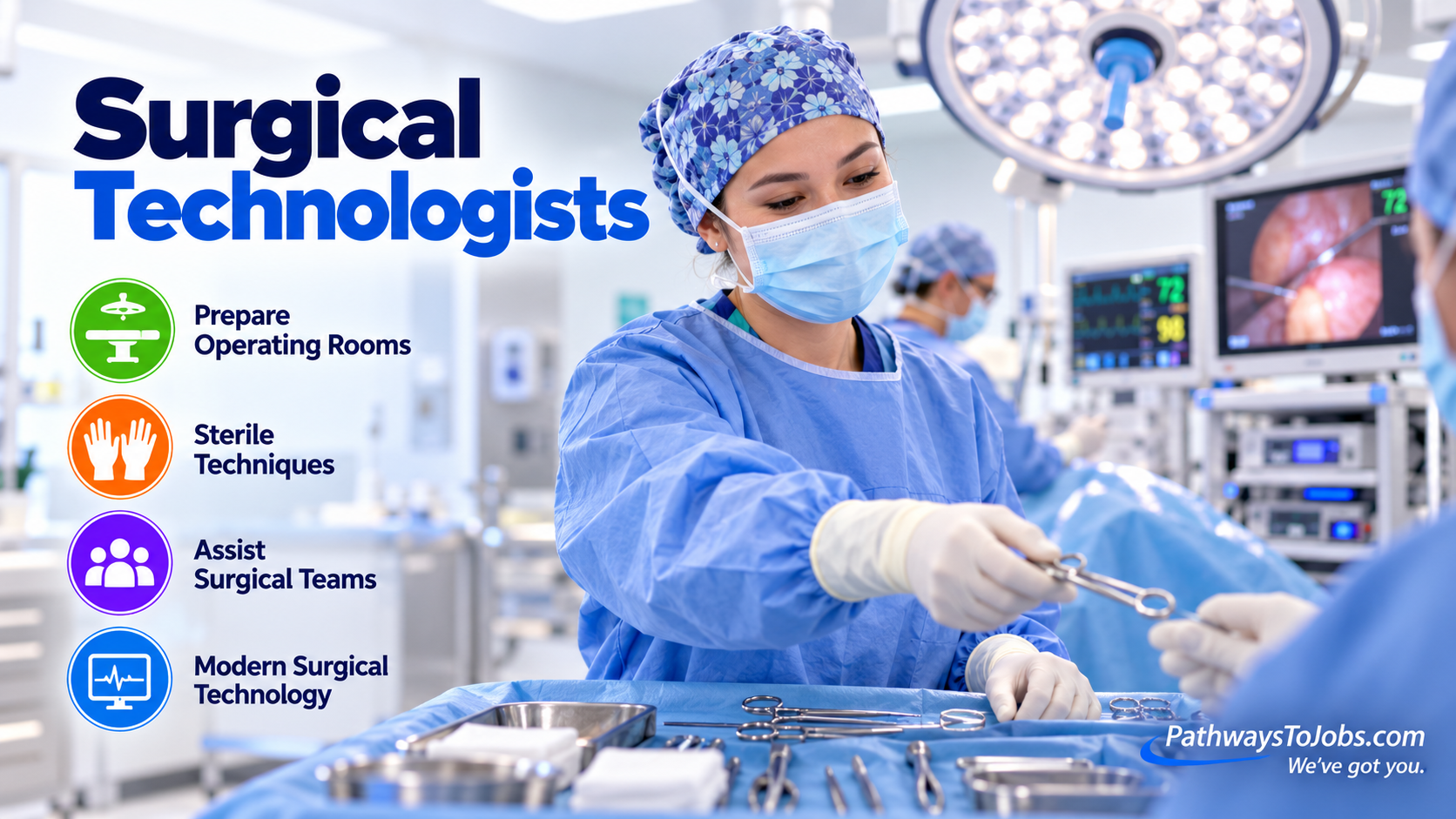
Surgical technologists are key members of the operating-room team. They prepare sterile instruments and equipment, help position and prepare patients, and support the surgical team throughout procedures. The role combines hands-on patient care, precision, technology, and teamwork.
Education
Most surgical technologists complete a postsecondary surgical technology program, typically lasting about 1–2 years, with classroom learning and supervised clinical experience. Programs cover areas such as anatomy, medical terminology, surgical procedures, sterilization, infection prevention, and surgical equipment. Certification or registration requirements vary by location.
Work Environment
Surgical technologists primarily work in hospitals and surgical centres, usually as part of a fast-moving operating-room team. The job involves standing for long periods, working with sterile equipment, and following detailed safety and infection-control procedures. Some positions include evenings, nights, weekends, holidays, or on-call shifts.
Future Outlook
Surgical technology continues to evolve as surgical techniques, medical devices, robotics, and operating-room technology advance. Demand for skilled surgical technologists is expected to remain steady, with opportunities influenced by healthcare needs, surgical volume, and advances in medical care.
Recommended High School Courses
- Chemistry
- Biology
- Math
- Computer Science
- Anatomy
- Health science
- Physiology
- Active Learning - Understanding the implications of new information for both current and future problem-solving and decision-making.
- Active Listening - Giving full attention to what other people are saying, taking time to understand the points being made, asking questions as appropriate, and not interrupting at inappropriate times.
- Complex Problem Solving - Identifying complex problems and reviewing related information to develop and evaluate options and implement solutions.
- Coordination - Adjusting actions in relation to others' actions.
- Critical Thinking - Using logic and reasoning to identify the strengths and weaknesses of alternative solutions, conclusions or approaches to problems.
- Equipment Maintenance - Performing routine maintenance on equipment and determining when and what kind of maintenance is needed.
- Instructing - Teaching others how to do something.
- Judgment and Decision Making - Considering the relative costs and benefits of potential actions to choose the most appropriate one.
- Learning Strategies - Selecting and using training/instructional methods and procedures appropriate for the situation when learning or teaching new things.
- Management of Material Resources - Obtaining and seeing to the appropriate use of equipment, facilities, and materials needed to do certain work.
- Monitoring - Monitoring/Assessing performance of yourself, other individuals, or organizations to make improvements or take corrective action.
- Operation and Control - Controlling operations of equipment or systems.
- Operation Monitoring - Watching gauges, dials, or other indicators to make sure a machine is working properly.
- Reading Comprehension - Understanding written sentences and paragraphs in work related documents.
- Service Orientation - Actively looking for ways to help people.
- Social Perceptiveness - Being aware of others' reactions and understanding why they react as they do.
- Speaking - Talking to others to convey information effectively.
- Time Management - Managing one's own time and the time of others.
- Customer and Personal Service - Knowledge of principles and processes for providing customer and personal services. This includes customer needs assessment, meeting quality standards for services, and evaluation of customer satisfaction.
- Education and Training - Knowledge of principles and methods for curriculum and training design, teaching and instruction for individuals and groups, and the measurement of training effects.
- English Language - Knowledge of the structure and content of the English language including the meaning and spelling of words, rules of composition, and grammar.
- Medicine and Dentistry - Knowledge of the information and techniques needed to diagnose and treat human injuries, diseases, and deformities. This includes symptoms, treatment alternatives, drug properties and interactions, and preventive health-care measures.
- Arm-Hand Steadiness - The ability to keep your hand and arm steady while moving your arm or while holding your arm and hand in one position.
- Category Flexibility - The ability to generate or use different sets of rules for combining or grouping things in different ways.
- Control Precision - The ability to quickly and repeatedly adjust the controls of a machine or a vehicle to exact positions.
- Deductive Reasoning - The ability to apply general rules to specific problems to produce answers that make sense.
- Far Vision - The ability to see details at a distance.
- Finger Dexterity - The ability to make precisely coordinated movements of the fingers of one or both hands to grasp, manipulate, or assemble very small objects.
- Flexibility of Closure - The ability to identify or detect a known pattern (a figure, object, word, or sound) that is hidden in other distracting material.
- Inductive Reasoning - The ability to combine pieces of information to form general rules or conclusions (includes finding a relationship among seemingly unrelated events).
- Information Ordering - The ability to arrange things or actions in a certain order or pattern according to a specific rule or set of rules (e.g., patterns of numbers, letters, words, pictures, mathematical operations).
- Manual Dexterity - The ability to quickly move your hand, your hand together with your arm, or your two hands to grasp, manipulate, or assemble objects.
- Multilimb Coordination - The ability to coordinate two or more limbs (for example, two arms, two legs, or one leg and one arm) while sitting, standing, or lying down. It does not involve performing the activities while the whole body is in motion.
- Near Vision - The ability to see details at close range (within a few feet of the observer).
- Number Facility - The ability to add, subtract, multiply, or divide quickly and correctly.
- Oral Comprehension - The ability to listen to and understand information and ideas presented through spoken words and sentences.
- Oral Expression - The ability to communicate information and ideas in speaking so others will understand.
- Perceptual Speed - The ability to quickly and accurately compare similarities and differences among sets of letters, numbers, objects, pictures, or patterns. The things to be compared may be presented at the same time or one after the other. This ability also includes comparing a presented object with a remembered object.
- Problem Sensitivity - The ability to tell when something is wrong or is likely to go wrong. It does not involve solving the problem, only recognizing there is a problem.
- Selective Attention - The ability to concentrate on a task over a period of time without being distracted.
- Speech Clarity - The ability to speak clearly so others can understand you.
- Speech Recognition - The ability to identify and understand the speech of another person.
- Trunk Strength - The ability to use your abdominal and lower back muscles to support part of the body repeatedly or continuously over time without 'giving out' or fatiguing.
- Visual Color Discrimination - The ability to match or detect differences between colors, including shades of color and brightness.
- Visualization - The ability to imagine how something will look after it is moved around or when its parts are moved or rearranged.
- Written Comprehension - The ability to read and understand information and ideas presented in writing.
- Written Expression - The ability to communicate information and ideas in writing so others will understand.
- Maintain sterile operative fields.
- Maintain inventory of medical supplies or equipment.
- Assist healthcare practitioners during surgery.
- Position patients for treatment or examination.
- Protect patients or staff members using safety equipment.
- Clean medical equipment or facilities.
- Prepare biological specimens for laboratory analysis.
- Sterilize medical equipment or instruments.
- Adjust settings or positions of medical equipment.
- Apply bandages, dressings, or splints.
- Operate diagnostic or therapeutic medical instruments or equipment.
- Order medical supplies or equipment.
- Monitor patient conditions during treatments, procedures, or activities.
- Record patient medical histories.
Schools

Potential Scholarships
Approx Salary Expectation

References
Trend Analysis - Explorer the Market, Labour Market Information, Government of Canada https://www.jobbank.gc.ca/trend-analysis.
O*NET OnLine, National Center for O*NET Development, https://www.onetonline.org/.