Material Handler / Warehouse Worker
Material Handler / Warehouse Worker
Career Overview
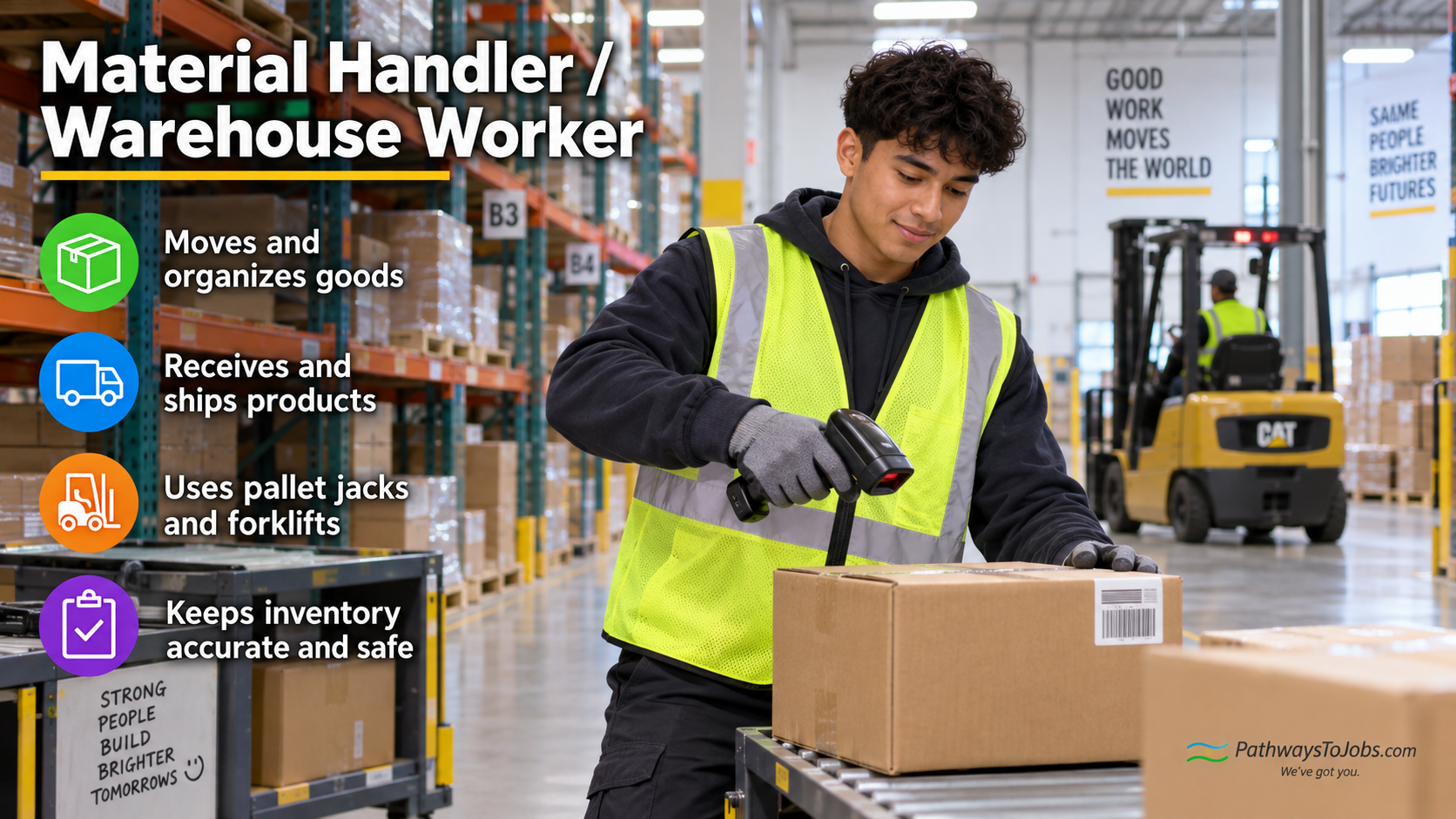
Material handlers and warehouse workers move, load, unload, sort, pack, and organize products and materials. They may use hand tools, forklifts, conveyors, and other equipment to keep goods moving safely through warehouses, factories, stores, and distribution centers.
Education
A high school diploma or equivalent can be helpful, but many material handler and warehouse worker jobs do not require formal education. Most workers receive training on the job. Training in workplace safety, equipment operation, and basic computer skills can be useful. Some jobs may require forklift certification.
Work Environment
Material handlers and warehouse workers may work in warehouses, distribution centers, manufacturing plants, stores, and shipping facilities. The work can involve lifting, standing, walking, and working around machinery. Some jobs include evenings, overnight shifts, weekends, or holidays
Future Outlook
Materials will continue to move through warehouses, distribution centers, manufacturing plants, and shipping facilities. Automation, robotics, conveyor systems, and automated storage technology are changing how goods are handled. Workers who can safely use equipment and adapt to new technology can build valuable skills for the future.
Recommended High School Courses
- Math
- Business
- Physical fitness
- Computer Studies
- Manufacturing Technology
- Workplace Safety
- Time Management - Managing one's own time and the time of others.
- Writing - Communicating effectively in writing as appropriate for the needs of the audience.
- Customer and Personal Service - Knowledge of principles and processes for providing customer and personal services. This includes customer needs assessment, meeting quality standards for services, and evaluation of customer satisfaction.
- Control Precision - The ability to quickly and repeatedly adjust the controls of a machine or a vehicle to exact positions.See more occupations related to this ability.
- Deductive Reasoning - The ability to apply general rules to specific problems to produce answers that make sense.See more occupations related to this ability.
- Dynamic Strength - The ability to exert muscle force repeatedly or continuously over time. This involves muscular endurance and resistance to muscle fatigue.See more occupations related to this ability.
- Extent Flexibility - The ability to bend, stretch, twist, or reach with your body, arms, and/or legs.See more occupations related to this ability.
- Far Vision - The ability to see details at a distance.See more occupations related to this ability.
- Manual Dexterity - The ability to quickly move your hand, your hand together with your arm, or your two hands to grasp, manipulate, or assemble objects.See more occupations related to this ability.
- Multilimb Coordination - The ability to coordinate two or more limbs (for example, two arms, two legs, or one leg and one arm) while sitting, standing, or lying down. It does not involve performing the activities while the whole body is in motion.
- Near Vision - The ability to see details at close range (within a few feet of the observer).See more occupations related to this ability.
- Oral Comprehension - The ability to listen to and understand information and ideas presented through spoken words and sentences.See more occupations related to this ability.
- Problem Sensitivity - The ability to tell when something is wrong or is likely to go wrong. It does not involve solving the problem, only recognizing there is a problem.See more occupations related to this ability.
- Speech Recognition - The ability to identify and understand the speech of another person.See more occupations related to this ability.
- Stamina - The ability to exert yourself physically over long periods of time without getting winded or out of breath.See more occupations related to this ability.
- Static Strength - The ability to exert maximum muscle force to lift, push, pull, or carry objects.
- Trunk Strength - The ability to use your abdominal and lower back muscles to support part of the body repeatedly or continuously over time without 'giving out' or fatiguing.See more occupations related to this ability.
- Written Comprehension - The ability to read and understand information and ideas presented in writing.
- Move materials, equipment, or supplies.
- Sort materials or objects for processing or transport.
- Load shipments, belongings, or materials.
- Mark materials or objects for identification.
- Receive information or instructions for performing work assignments.
- Review work orders or schedules to determine operations or procedures.
- Record operational or production data.
- Secure cargo.
- Position material handling equipment.
- Operate cranes, hoists, or other moving or lifting equipment.
- Monitor cargo area conditions.
- Clean facilities or work areas.
- Package materials or products.
- Connect cables or electrical lines.
- Shovel materials.
- Set up material handling gear or equipment, such as rigging, packaging, or temporary structures.
- Maintain material moving equipment in good working condition.
- Operate packing or other material processing equipment.
Potential Scholarships
Approx Salary Expectation


References
Trend Analysis - Explorer the Market, Labour Market Information, Government of Canada https://www.jobbank.gc.ca/trend-analysis.
O*NET OnLine, National Center for O*NET Development, https://www.onetonline.org/.